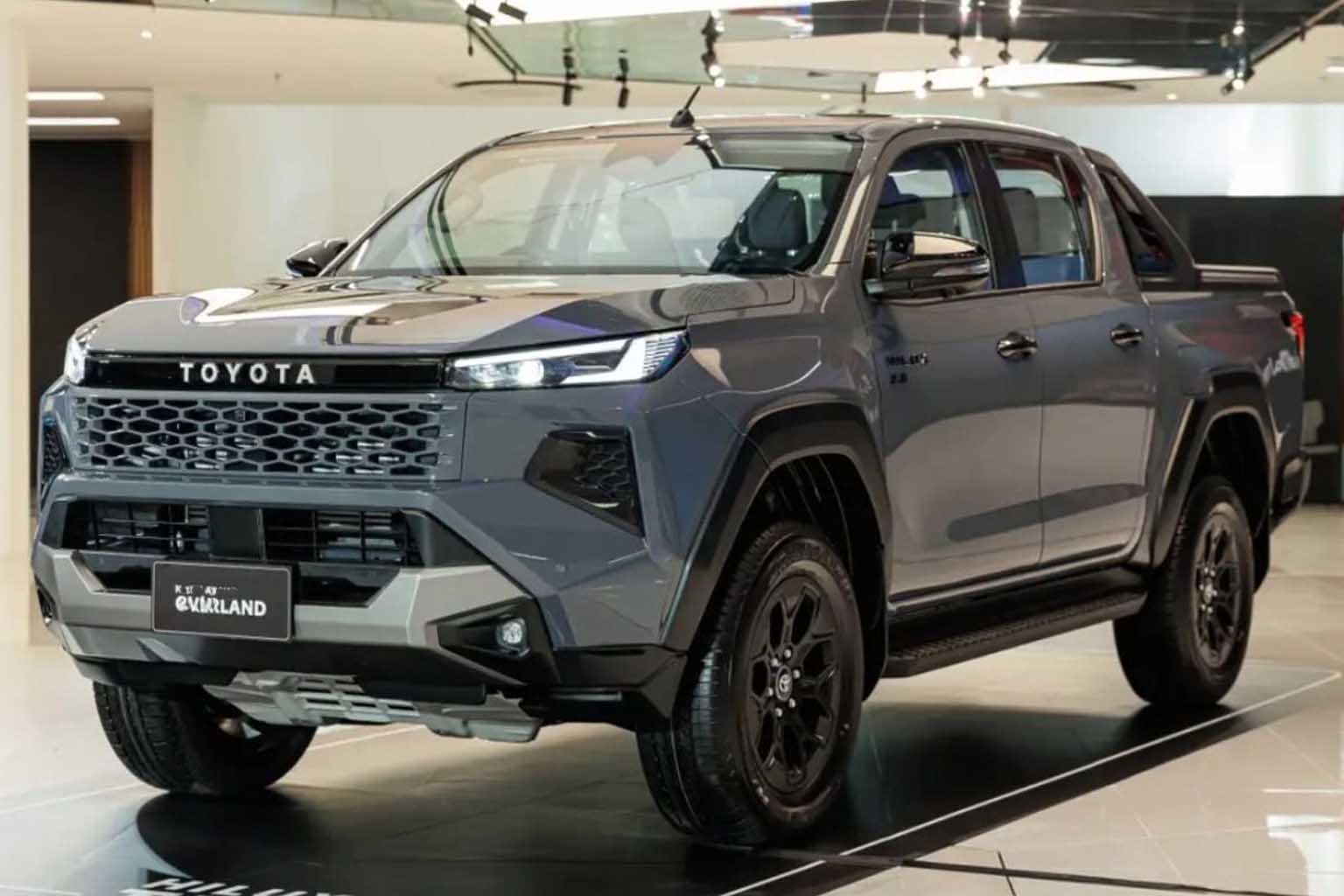
If there is one vehicle that has genuinely earned its reputation on Nigerian roads, it is the Toyota Hilux. From the oil fields of the Niger Delta to the rugged terrain of Plateau State, from corporate fleet pools to personal workhorses, the Hilux is everywhere because it works. The 2027 model builds on a lineage that has made it one of the most trusted pickups on the planet, and for Nigerian buyers, the calculus of why to buy one has only gotten stronger.
Toyota has updated the Hilux for 2027 with revised front-end styling that brings it closer to the Land Cruiser family's current design language, a refreshed interior with improved technology features including a larger touchscreen, wireless phone integration, and expanded driver assistance systems on upper trims.
The powertrain continues with the proven 2.8-litre turbocharged diesel four-cylinder — the engine that has made generations of Hilux buyers confident on long cross-country runs. Output is 204 horsepower and a substantial 500Nm of torque, paired with a six-speed automatic on most trims or a manual on working-specification variants.
Pricing spans a significant range depending on the specification. The base Single Cab workhorse variants start around N22 million. The popular Double Cab GR Sport and Legend variants that most Nigerian private buyers prefer are priced between N80 million and N118 million from authorised dealers.
Tokunbo Hiluxes are widely available and present good value. A clean 2023 or 2024 Double Cab from UAE or Australia — the main export markets for used Hilux stock coming into Nigeria — costs between N50 million and N68 million depending on mileage, specification, and condition at importation.
The Hilux's combination of attributes is almost perfectly matched to Nigerian conditions. The diesel engine's torque is ideal for loaded highway running and off-road terrain. The body-on-frame construction means repairs can be done straightforwardly without the specialist alignment tools that monocoque vehicles require. Ride height is sufficient for many rural roads that would challenge lower-slung vehicles.
Parts availability is perhaps the strongest argument of all. The Hilux uses a parts ecosystem that is so deeply embedded in the Nigerian market that even mechanics in smaller towns are familiar with its components. This is not something to take lightly when a vehicle breakdown away from major cities is a real possibility.
For private buyers, the Double Cab GR Sport or Rogue variants offer the best combination of capability and comfort. The GR Sport adds sportier styling, upgraded suspension tuning, and interior enhancements. The Legend (or equivalent premium trim in some market configurations) is the most comfortable for daily driving while retaining the Hilux's core capabilities.
For fleet and commercial use, the Single Cab and Extra Cab configurations with the manual gearbox make economic sense — simpler, more repairable, and lower upfront cost.
The Hilux is genuinely one of the lowest total-cost-of-ownership vehicles in its category in Nigeria. Diesel consumption is reasonable given the vehicle's capability — expect 9 to 12 litres per 100km. Service intervals are manageable, parts are cheap relative to European or American alternatives, and the vehicle depreciates slowly, meaning your exit value when you eventually sell is strong.


 Welcome!
Comments