How to Spot a Flood Damaged Car in Nigeria 2026 Guide
Avoid buying a "washed" car. Learn the expert signs of flood damage in Nigeria, from Tokunbo car secrets to engine checks. Save millions with our 2026 guide.
It is a sunny afternoon at a popular car lot in Berger, Lagos. You see it. A gleaming, metallic-grey sedan that looks like it just rolled off a German assembly line. The dealer calls it a clean Tokunbo car, a direct import with full options and zero faults. The price seems just a bit too good to be true, but you are blinded by the fresh wax and the scent of new car spray.
Fast forward three months. You are stuck in the middle of the Third Mainland Bridge during rush hour. The dashboard has lit up like a Christmas tree, the engine is coughing, and a strange, earthy smell is rising from the floorboards. You have just discovered what thousands of Nigerian car buyers realise too late every year: you bought a flooded vehicle.
As we move through 2026, the risk of buying a waterlogged vehicle is higher than ever. With global climate shifts causing unprecedented rainfall across Europe and North America, many cars being shipped to the West African coast were actually written off as flood salvage in their home countries. Locally, recent flash floods in states like Kogi, Anambra, and parts of Lagos have added a wave of Nigerian-used cars to the market that have spent days submerged in brown water.
If you are planning to invest your hard-earned millions into a vehicle this year, you cannot afford to be sentimental. You need to be a detective. The best way to start is by browsing verified listings on a professional marketplace like carlots.ng, where seller transparency is prioritised.
The Psychology of the Washed Car Dealer
Before diving into the technical checks, it is important to understand how these cars end up on the lot. A flood-damaged vehicle is usually a total loss for an insurance company in the US or Europe. Shrewd exporters buy them for pennies on the dollar, bring them to workshops in Cotonou or Lagos, and perform what is known as a deep wash.
They strip the interior, dry the seats in the sun, steam-clean the engine bay, and spray industrial-grade deodorisers to mask the scent of mildew. On the surface, the car looks perfect. But water is a patient enemy. It hides in the wiring harnesses, the air bag sensors, and the crevices of the transmission. By the time the corrosion sets in, the dealer is long gone, and you are left with a mechanical nightmare.
1. Trust Your Nose: The Olfactory Test
The most difficult thing to hide in a flooded car is the smell. Mould and mildew have a very specific, pungent, and earthy odour that is almost impossible to eliminate once it gets into the seat foam or the padding under the carpet.
When you first approach the car, ask the dealer to keep the doors and windows closed for at least ten minutes before you arrive. When you open the door, take a deep breath. Do you smell a damp locker room? Or, perhaps more suspiciously, do you smell an overwhelming amount of air freshener? Dealers often use strong scents to mask the lingering smell of swamp water.
The Heater and A/C Check
Turn on the car and switch the air conditioning to the highest heater setting. Let it run for a few minutes. If the air coming out of the vents starts to smell like a wet dog or a damp basement, there is moisture trapped in the HVAC system. This is a classic sign that water rose high enough to enter the dashboard area.
2. Peek Under the Skin: Interior Red Flags
A car might look clean, but sellers rarely go through the trouble of cleaning the places people do not usually look.
The Seat Belt Pro-Tip
Pull the seat belts all the way out to their absolute limit. Do it slowly. Look for a tide line or a change in colour on the fabric of the belt. If the end of the belt is discoloured, stained with silt, or feels slightly grimy, that car was likely submerged. Most detailers forget to clean the part of the belt that stays retracted inside the pillar.
The Carpet and Padding
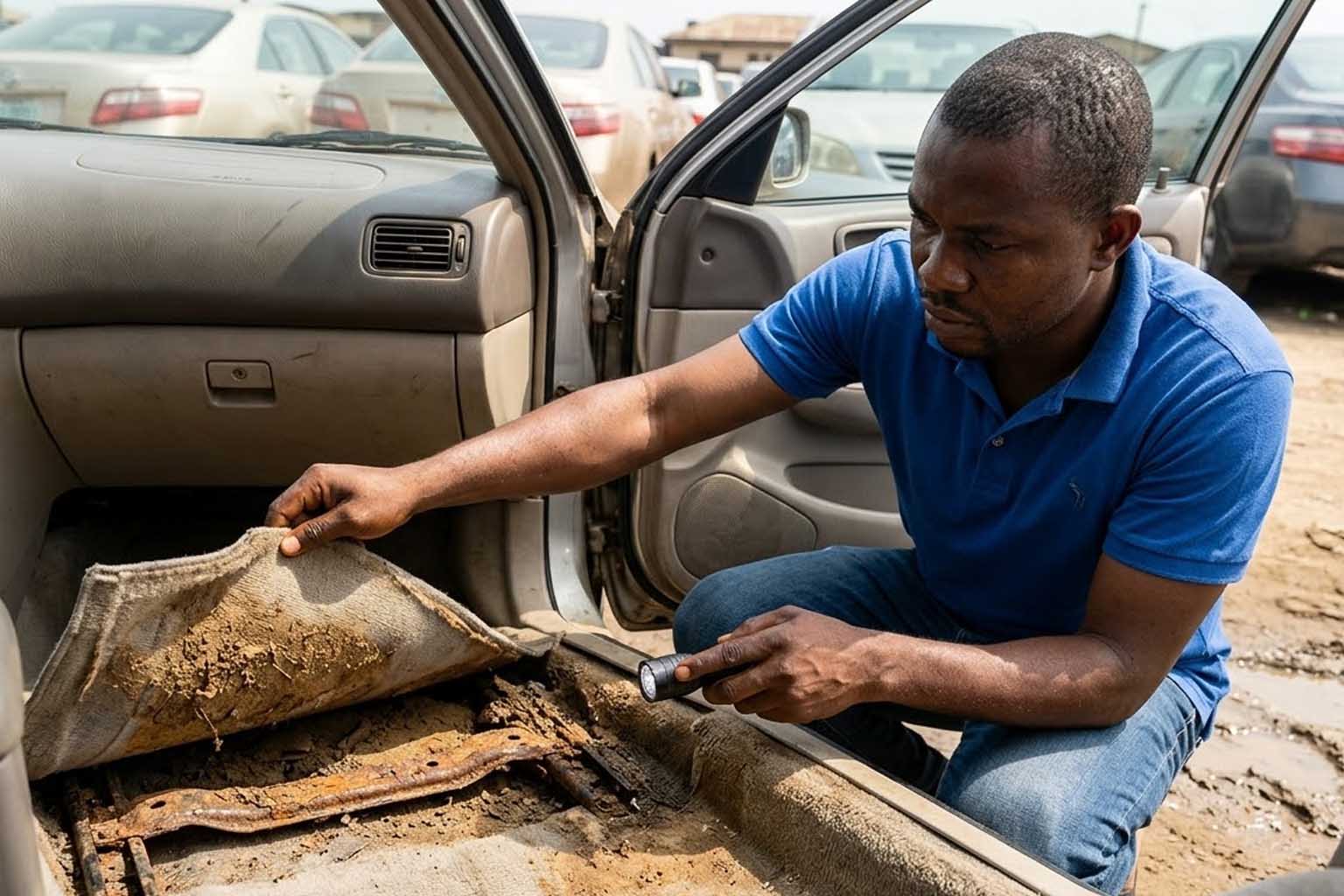
Go to a corner of the car, usually near the pedals or under the passenger seat, and try to pull up a small section of the carpet. You are looking for two things: silt and moisture. If you find fine sand or dried mud underneath the carpet, that is a smoking gun. Furthermore, check the insulation padding under the carpet. If it feels crunchy or shows signs of being replaced while the rest of the interior looks old, be wary.
Seat Rails and Bolts
Get a flashlight and look at the metal rails the seats slide on. In a normal car, these should be clean or perhaps a bit dusty. In a flooded car, you will often find heavy orange rust or pitting on the metal. Check the heads of the bolts that hold the seats to the floor. If they are rusted or show signs of having been removed recently, it means the seats were pulled out to be dried.
3. The Electrical Gremlins
Modern cars are essentially computers on wheels. When water hits the intricate sensors and control modules, the damage is often permanent. Even if the car runs today, the copper wiring will begin to oxidise and turn green over the next few months.
The Dashboard Warning Lights
Turn the ignition to the On position without starting the engine. Every single warning light (ABS, Airbag, Check Engine, Battery) should light up. This is a self-test. If some lights do not come on, a dishonest seller might have disconnected them to hide a permanent fault caused by water damage. Once you start the engine, all those lights should disappear. If they flicker or stay on, walk away.
Testing Every Switch
You must be tedious here. Test the power windows, the sunroof, the door locks, the interior lights, and the radio. Do the windows move slowly or make a grinding sound? These are signs that moisture has compromised the electrical regulators.
4. Under the Hood: The Mechanical Audit
A flooded engine is a ticking time bomb. If water enters the combustion chamber while the engine is running, it can cause hydro-lock, which effectively shatters the internal components.
The Dipstick Confession
Pull the engine oil dipstick. If the oil looks like a pale, creamy chocolate milkshake, do not buy that car. That colour indicates that water has mixed with the oil. The same goes for the transmission fluid; it should be red or amber, not milky or cloudy.
Hidden Silt in the Engine Bay
Look for mud or silt in places where it should not be, such as inside the alternator, behind the cooling fans, or in the crevices of the intake manifold. While a dealer might wash the top of the engine, they rarely get into the small gaps where floodwater leaves its signature.
5. The VIN and Documentation Strategy
In 2026, technology is your best friend. Before you even travel to look at a Tokunbo car, ask the seller for the Vehicle Identification Number (VIN).
Run a History Report
If a car is involved in a flood in the US or Canada, it will often be issued a Salvage or Flood title. Many of these vehicles are exported to Nigeria because buyers here often rely only on physical appearance. Always use a trusted platform like carlots.ng to browse listings where you can verify seller details and car history. You can also cross-reference these details with international databases like Carfax or AutoCheck to see the original status before it reached Nigerian shores.
Conclusion: Don't Let Fine Body Deceive You
Buying a car in Nigeria is a significant milestone. Whether it is your first car or an upgrade for your family, it represents a huge financial commitment. A flood-damaged car is not just a bad investment; it is a safety risk. Brakes can fail, airbags might not deploy, and the car can stall in dangerous traffic.
The golden rule for 2026 is simple: if the deal feels too good to be true, it probably is. Take your time, bring a trusted mechanic with an OBD-II diagnostic scanner, and use your senses. A little bit of extra scrutiny today can save you millions of Naira in repairs tomorrow. For the safest buying experience, stick to reputable marketplaces like carlots.ng to filter for the best quality vehicles.