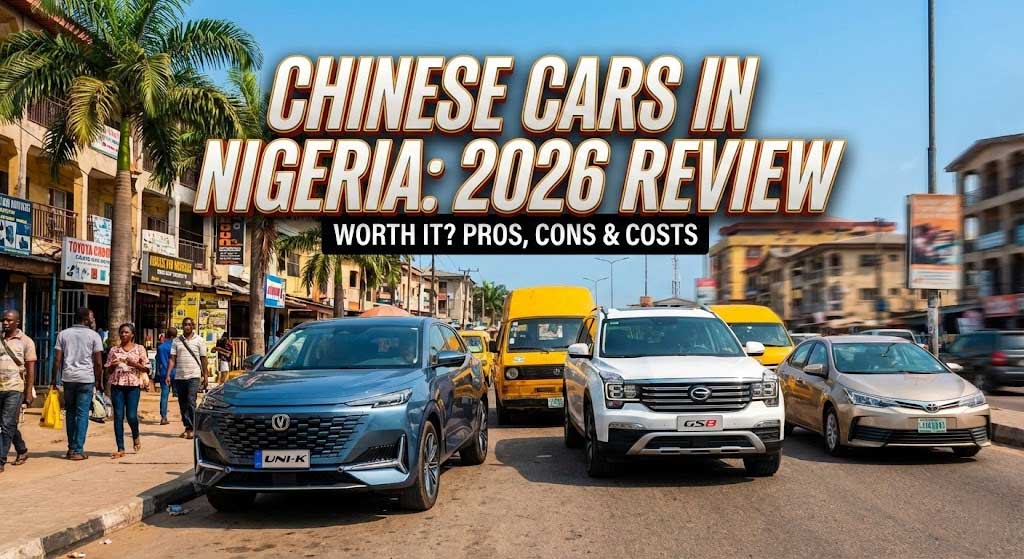
If you drove through the Lekki-Epe Expressway or the Central Business District in Abuja five years ago, the roads were a sea of Toyota Corollas, Honda Accords, and Lexus SUVs. Fast forward to 2026, and the landscape has shifted. You are just as likely to spot a sleek GAC GS4, a futuristic Changan Uni-K, or a Geely Coolray zooming past Danfos.
With the price of a foreign-used ("Tokunbo") Toyota Highlander hitting dizzying heights, many Nigerians are asking a critical question: Are Chinese cars in Nigeria finally a safe bet, or are they still a risky gamble?
It’s no longer just about affordability. These manufacturers are offering extended warranties, leather interiors, and tech that would cost double in a German car. But what happens when the warranty expires? How do they handle Nigerian potholes?
In this deep dive, we strip away the marketing hype to look at the real ownership experience of Chinese cars in Nigeria in 2026.
Before we talk costs, let's identify who is actually dominating the market. The "Chinco" stigma of the early 2000s is fading fast, thanks to partnerships with major Nigerian conglomerates like CIG Motors and Mikano.
GAC Motor: arguably the current leader in trust. Their partnership with the Lagos State Government for the "LagRide" project put thousands of their cars on the road, proving their durability in arguably the harshest driving conditions in the world.
Changan: Known for stunning designs. If you see an SUV that looks like a spaceship, it’s probably a Changan.
Geely: They own Volvo, and it shows. The build quality in 2026 Geely models often feels European.
Chery & JAC: Strong contenders offering budget-friendly pickups and sedans that are becoming favourites for corporate fleets.
Let’s be real—buying a brand-new Toyota or Mercedes in 2026 requires a budget that most salary earners can only dream of.
The Reality: A brand new Changan Alsvin or GAC GA4 often costs less than a 6-year-old foreign-used Toyota Corolla.
The Perk: You get that "tear rubber" smell, zero mileage, and no hidden history of accidents or floods from the US.
Most Chinese dealers in Nigeria now offer warranties ranging from 3 to 5 years (or 100,000km to 150,000km).
Note: This is a game-changer. If your engine knocks or your transmission fails in Year 2, the dealer fixes it for free. Try getting that guarantee from a Tokunbo car dealer in Berger.
Chinese OEMs (Original Equipment Manufacturers) don’t skimp on features. Even entry-level models in 2026 come equipped with:
360-degree cameras (essential for squeezing through Lagos traffic).
Panoramic sunroofs.
Large touchscreens with Apple CarPlay/Android Auto.
Advanced safety tech like blind-spot monitoring.
This remains the biggest elephant in the room.
Toyota/Honda: You can buy a Corolla for ₦15M and sell it two years later for ₦14M (or more, given inflation).
Chinese Cars: Depreciation is steeper. The market for used Chinese cars is growing but hasn't fully matured yet. Buyers are still sceptical about buying a 5-year-old Chinese vehicle, which pushes resale prices down.
If you drive a Toyota, you can buy a side mirror or brake pad in Ladipo, Oyingbo, or practically any mechanic village in Nigeria.
The Struggle: For a GAC or Geely, you are often tied to the dealership for parts. While dealership stock has improved significantly in 2026, it means you can't just pop into a roadside shop to fix a broken taillight cheaply. You have to wait for the dealer and pay dealer prices.
While engines have proven reliable (many use technology licensed from Mitsubishi or developed with European partners), smaller components can be annoying. We’ve seen reports of:
Touchscreens freeze in extreme heat.
Chrome trims peel faster than expected.
Suspension bushings are wearing out quickly on bad roads (though this happens to all cars in Nigeria).
Let’s compare the ownership costs of a popular Chinese SUV versus a popular Japanese alternative over a period of 3 years.
Scenario: A mid-level executive in Lagos looking for a reliable daily driver.
| Feature | GAC GS4 / Changan CS35 (Brand New) | Toyota RAV4 (2018/19 Model - Tokunbo) |
| Purchase Price (Est.) | ₦38,000,000 - ₦45,000,000 | ₦36,000,000 - ₦42,000,000 |
| Warranty | 5 Years / 150,000km | None (Sold "As is") |
| Insurance (Comprehensive) | ~₦1.8M per year (variable) | ~₦1.6M per year |
| Maintenance (Year 1-3) | Low, mostly oil changes (free labour often included). | Medium/High. Likely needs shocks, tyres, or AC work immediately. |
| Fuel Economy | 10–12 km/L (Turbo engines are efficient) | 10–13 km/L (Proven efficiency) |
| Resale Value (Year 3) | Est. ₦20M - ₦25M | Est. ₦30M - ₦35M |
The Chinese car wins on upfront peace of mind. You won't spend your first three months visiting mechanics. However, the Toyota wins on exit strategy—when you want to sell, you will recover more of your money.
This is the most common question we get.
Suspension:
Newer 2026 models from GAC and Geely have reinforced suspensions specifically tuned for "emerging markets" (a polite way of saying bad roads). They handle potholes better than the Chinese cars of 2015, but they are generally stiffer than the pillow-soft ride of a Lexus RX.
Air Conditioning:
Chinese manufacturers know their audience. The AC systems in these cars are freezing cold—comparable to, and sometimes better than, Korean cars.
Engine & Transmission:
Most reliable Chinese brands now use Aisin gearboxes (Japanese) or Bosch electronics (German). The mechanical core of the car is usually solid. The issues usually arise with sensors and electronics.
You should buy one if:
You want a brand new car experience without spending ₦80M+.
You plan to keep the car for at least 5-7 years (driving it until the depreciation curve flattens).
You live in a major city (Lagos, Abuja, PH) where dealership support is easily accessible.
You value tech and modern interiors over badge prestige.
You should stick to Toyota/Lexus if:
You change cars every 2 years.
You live in a remote area far from authorised service centres.
You view your car strictly as a financial asset that must hold value.
In 2026, Chinese cars in Nigeria are no longer "inferior" alternatives; they are legitimate competitors offering a different value proposition. They trade resale value for immediate luxury and warranty protection.
If you are tired of buying "Tokunbo" cars that come with other people's problems, brands like GAC, Changan, and Geely offer a refreshing, stress-free ownership experience. Just remember: marry the car for a few years, enjoy the warranty, and don't expect it to hold its value like a Toyota.


 Welcome!
Comments