
Top 5 Fuel-Efficient Cars to Survive Nigerian Petrol Prices in 2026
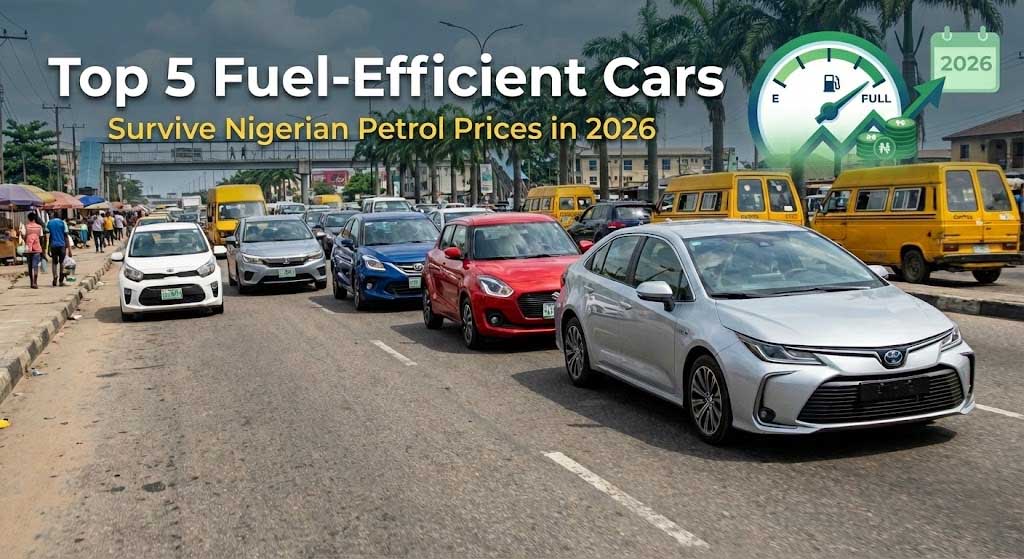
If you are tired of watching your fuel gauge drop faster than a stone, you are reading the right guide. We have curated the top 5 Fuel-Efficient Cars that blend reliability, availability of parts in Ladipo or Apo Mechanic Village, and, most importantly, engines that sip fuel rather than gulp it.
With petrol prices hovering around the ₦820 per litre mark (and sometimes higher depending on where you are), the conversation at the pump has changed. We aren't just asking "How much?" anymore; we are asking, "How far can this take me?"
In 2026, driving a V6 or V8 engine in Lagos traffic isn't just a flex; it’s a liability. The new luxury isn't leather seats or a panoramic sunroof, it's fuel efficiency. Whether you are navigating the gridlock on the Third Mainland Bridge or making a long trip down to the East, the car you drive determines whether your salary stays in your pocket or goes straight into the nozzle.
If you are tired of watching your fuel gauge drop faster than a stone, you are reading the right guide. We have curated the top 5 Fuel-Efficient Cars that blend reliability, availability of parts in Ladipo or Apo Mechanic Village, and, most importantly, engines that sip fuel rather than gulp it.
1. Toyota Corolla Hybrid (The undisputed King)
You cannot talk about Nigerian roads without mentioning the Toyota Corolla. But for 2026, we aren't looking at the standard petrol model; we are looking at the Corolla Hybrid.
Why it wins: Toyota’s hybrid system is legendary. In stop-and-go traffic (which is 90% of Lagos driving), the electric motor takes over, meaning you burn zero petrol while creeping forward in a 'go-slow'. When the road clears, the petrol engine kicks in seamlessly.
-
Real-World Efficiency: ~23–26 km/L (approx. 3.8–4.3 L/100km).
-
The Nigerian Context: Early fears about "hybrid batteries" in Nigeria are fading. Mechanics in major cities are now trained to handle them, and battery replacements are becoming easier to source.
-
Verdict: It’s the perfect daily driver for the salary earner who wants peace of mind.
2. Suzuki Swift (The "Sip-Do n't-Gulp" Champion)
If you’ve noticed more Suzukis on the road lately, it’s not a coincidence. The Suzuki Swift has earned a reputation as a "fuel miser." It is lightweight, agile, and refuses to visit the filling station often.
Why it wins: The Swift uses a super-efficient 1.2L Dualjet engine. Because the car is so light, the engine doesn't have to work hard to move it. It’s fantastic for manoeuvring through tight spaces in Yaba or Wuse.
-
Real-World Efficiency: ~20–22 km/L (approx. 4.5–5.0 L/100km).
-
The Nigerian Context: Suzuki’s partnership with CFAO and Toyota (some parts are shared) means maintenance is cheap. It’s not a luxury car, but your bank account will thank you.
-
Verdict: The best choice for students, young professionals, or anyone doing Bolt/Uber part-time.
3. Toyota Starlet Cross / Suzuki Fronx (The Pothole Survivor)
Let’s face it—our roads aren't always smooth. Sometimes you need a car that sits a bit higher to avoid scraping the undercarriage on a bad road in Ota or Aba. Enter the Toyota Starlet Cross (also sold as the Suzuki Fronx).
Why it wins: It combines the fuel economy of a small hatchback with the rugged stance of an SUV. It uses a 1.5L engine that is punchy but surprisingly frugal. It gives you that "big car" feel without the "big car" fuel bill.
-
Real-World Efficiency: ~17–19 km/L (approx. 5.3–5.8 L/100km).
-
The Nigerian Context: The raised ground clearance is a lifesaver for Nigerian roads. Plus, it has a high resale value because... well, it's a Toyota.
-
Verdict: The perfect middle ground for families who need a crossover but can’t afford a RAV4’s running costs.
4. Honda City (The Highway Cruiser)
Honda sometimes gets a bad rap in Nigeria for "ball joint" issues (mostly older models), but the modern Honda City is a different beast. It is built tough and engineered for serious efficiency.
Why it wins: The Honda City uses "Earth Dreams" technology, which is just a fancy way of saying the engine maximizes every drop of fuel. It is smoother and more comfortable than the Swift or Picanto, making it great for longer commutes, like driving from Mowe-Ibafo to the Island daily.
-
Real-World Efficiency: ~16–18 km/L (approx. 5.5–6.2 L/100km).
-
The Nigerian Context: The AC in a Honda is legendary—it chills faster than a freezer, which is essential for our weather. Just ensure you use a mechanic who understands modern Honda CVTs.
-
Verdict: A sleek, executive-looking sedan that doesn't punish your wallet.
5. Kia Picanto (The Lagos Traffic Warrior)
Small, mighty, and everywhere. The Kia Picanto is the ultimate city runabout. It might not command respect on the highway, but when everyone else is stuck at the pump, you’ll be zooming past.
Why it wins: It has a tiny 1.0L or 1.2L engine. It physically cannot consume much fuel because the cylinders are so small. It’s arguably the cheapest car to run in Nigeria right now.
-
Real-World Efficiency: ~18–20 km/L (approx. 5.0–5.5 L/100km).
-
The Nigerian Context: Parts are incredibly cheap and available in every market. It’s also easy to park in tight spaces.
-
Verdict: If your priority is purely "lowest cost from Point A to Point B," this is your winner.
Quick Comparison: The Numbers Game
Here is how they stack up side-by-side.
| Car Model | Engine Type | Est. Real-World Mileage (City) | Tank Range (Approx.) | "Mechanic Friendliness" Score |
| Toyota Corolla Hybrid | 1.8L Hybrid | 25 km/L | 850km+ | 7/10 (Requires specialist) |
| Suzuki Swift | 1.2L Petrol | 21 km/L | 700km+ | 9/10 (Very Easy) |
| Toyota Starlet Cross | 1.5L Petrol | 18 km/L | 650km+ | 9/10 (Very Easy) |
| Honda City | 1.5L Petrol | 17 km/L | 600km+ | 8/10 (Moderate) |
| Kia Picanto | 1.0L/1.2L Petrol | 19 km/L | 600km+ | 10/10 (Easiest) |
Note: "Mechanic Friendliness" refers to how easy it is to find a roadside mechanic in Nigeria who can fix it without complicating issues.
Buying Tips: Don't Buy "Problem"
Before you rush to OLX, Jiji, or your local car dealer to pick one of these up in 2026, keep these tips in mind:
-
Hybrid Health Check: If buying a used Corolla Hybrid (Tokunbo), do not just kick the tyres. Pay a specialist to scan the hybrid battery cells. A weak battery will kill your fuel savings.
-
The CVT Factor: Most modern, efficient cars (Honda City, newer Toyotas) use CVT gearboxes. These require specific transmission fluid. If your mechanic pours standard "red oil" (ATF) into a CVT, your gearbox will fail within weeks. Be vigilant.
-
Tyres Matter: Fuel efficiency drops if your tyres are under-inflated. With the state of our roads, ensure you have good quality tyres and check pressures weekly.
Conclusion
Surviving the petrol prices of 2026 isn't about stopping driving; it's about driving smarter. The days of buying a car solely for its size or sound are behind us. The Toyota Corolla Hybrid offers the best tech, the Suzuki Swift offers the best value, and the Starlet Cross handles our roads the best.
Choosing any of these five vehicles will ensure that when the next fuel scarcity hits, or prices creep up again, you’ll be the one smiling—or at least, panicking less than the guy in the V8 SUV next to you.