
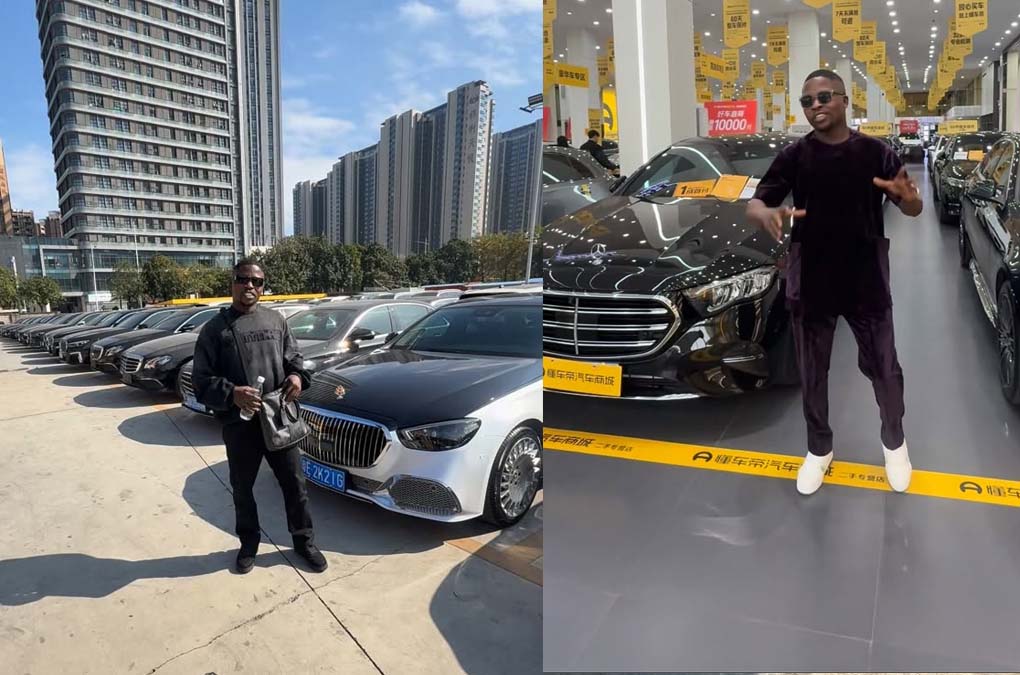
For decades, the “Nigerian Dream” of car ownership followed a specific script: save up millions, find a reliable dealer in Lagos or Cotonou, and buy a “clean title” Toyota or Mercedes-Benz imported from Texas or Toronto. But the script has flipped.
With the Naira dancing uncomfortably around the exchange rate and customs duties hitting the roof, the traditional “Tokunbo” market from the US and Canada is choking. Enter the Dragon. A massive shift is happening right now in the Nigerian automotive space: China Imports.
From Lekki to Abuja, savvy buyers are realising they can drive a 2025 Mercedes-Benz for the price of a 2018 model if they just look East. But as the saying goes, “better soup na money kill am.” Is this too good to be true?
Table of contents
We investigated the data, spoke to industry heavyweights like Komiyo Lawrence Adefemi (CEO of Fekomi), and broke down exactly what “China Specs” mean for your pocket and your peace of mind.
The Price Gap: The Numbers Don’t Lie
The catalyst for this shift is simple economics. The price difference between a car imported from China and one from the US or Europe is not just a gap; it’s a gulf.
Komiyo Lawrence Adefemi, the CEO of Fekomi and a vocal figure in the Nigerian luxury space, recently dropped figures that have the entire auto industry buzzing. According to his data, the arbitrage opportunity is massive.
The Fekomi Breakdown:
- Mercedes-Benz C300 (2025 Model):
- China Import Cost: ~₦60 Million (Landing cost with shipping & clearing).
- Nigeria Dealer Price (2023 Model): ~₦100 Million.
- The Kicker: Adefemi notes that many of the ₦100M US-spec cars sold locally are actually repaired accident vehicles, whereas the China import is clean.
- Mercedes-Benz S-Class (2025 Model):
- China Import Cost: ~₦110 Million.
- Nigeria Dealer Price: ₦280 Million – ₦350 Million.
- Savings: You could literally buy two S-Classes from China for the price of one in Nigeria.
- Low Mileage Deals:
- A 2025 vehicle with just 4,000 miles on the clock is landing for roughly ₦110 Million from China.
- The same car sits in Nigerian showrooms with price tags between ₦190 million and ₦250 million.
Key Takeaway: Nigerians are paying a “US Spec Premium” of nearly 100% simply because of habit and fear of the unknown.
What Exactly is “China Specs”? (It’s Not What You Think)
There is a huge misconception in Ladipo and broad mechanic workshops that “China Spec” means “Fake” or “Substandard.” This is false.
Major manufacturers like Toyota, Mercedes-Benz, and Honda have massive joint-venture factories in China (e.g., Beijing-Benz, FAW-Toyota). These factories build cars to global standards, but they tweak them for the Chinese market.
Here is how China specs differ from the US specs Nigerians are used to:
1. The “L” Factor (Long Wheelbase)
In China, luxury is defined by rear-seat space because wealthy Chinese owners are often chauffeur-driven.
- Mercedes & BMW: You will often see a “C260L” or “E300L” in China. The “L” stands for Long Wheelbase. These cars are literally longer than their US counterparts, offering S-Class-level legroom in a C-Class body.
- The Benefit: For a Nigerian “Oga” who sits at the back, Chinese specs are actually more comfortable than US specs.
2. Engine Displacement
China taxes cars heavily based on engine size.
- US Spec: Might come with a 3.5L V6.
- China Spec: Will often use a high-powered 2.0L Turbo or 1.5L Turbo to produce similar horsepower but beat the tax man.
- Implication: Better fuel economy for Nigerians, but slightly different driving dynamics.
3. Technology & Aesthetic
- Toyota: A Chinese Toyota Camry or Corolla often has more “bling”—more chrome on the grill and fancier LED lights—compared to the sporty, understated US look.
- Tech: The infotainment systems are advanced but localised (more on this in the risk section).
The Risks: What You Must Know Before Sending Money
While saving ₦100 Million sounds sweet, buying a Toyota, Mercedes-Benz, or Lexus from China comes with specific “Wahala” you need to be ready for.
1. The Language Barrier (The Dashboard Problem)
This is the most immediate annoyance.
- The Issue: The default language on the dashboard and infotainment screen is Mandarin. While the instrument cluster can often be switched to English via settings, the Navigation and deeply embedded apps (like Baidu Maps) are locked to China.
- The Fix: You may need to pay a software engineer in Ikeja Computer Village to “flash” the system to Global/English firmware. This costs money and voids warranties.
2. The “No Carfax” Black Hole
This is the biggest risk.
- US Cars: You can run a Carfax or Autocheck using the VIN (Chassis Number) to see if the car was flooded in Florida or wrecked in Texas.
- China Cars: There is no global “Carfax” for China. You are relying 100% on the honesty of your importer. If a car were flooded in Beijing and repaired, you might never know until the electronics start failing on the Third Mainland Bridge.
3. Spare Parts Compatibility
While a C300 engine is largely the same globally, the body parts can be a nightmare.
- Remember the “Long Wheelbase” mentioned earlier? If you buy a China-spec C-Class L and someone bashes your rear door in Lagos traffic, you cannot just go to Ladipo market and buy a standard US C-Class door. It won’t fit. You will have to order that door specifically from China, which could take weeks.
4. Resale Value
The Nigerian market is slow to adapt. If you try to sell your China-spec car in 2 years, dealers might price it lower than a US spec because they perceive it as “lesser,” even if it is newer and cleaner.
Comparison: Which Spec is Preferable for Nigerians?
If you are confused about which route to take, use this guide:
| Feature | US/Canada Spec | GCC (Dubai) Spec | China Spec |
| Cooling (AC) | Good, but rarely upgraded. | Excellent. Built for desert heat (best for Nigeria). | Good. Similar to Global standards. |
| History Check | Best. (Carfax available). | Mixed. Hard to trace history. | Poor. Difficult to verify history. |
| Spare Parts | Excellent. Ladipo is full of them. | Good. | Moderate. Engine parts are fine; body parts can be tricky. |
| Price | Expensive (High duty & FX). | Moderate. | Cheapest. (Best value for money). |
| Tech/Features | Standard. | Standard. | High Tech. (Often has panoramic screens/ambient light). |
The Verdict: Who Should Buy What?
- Buy US Spec if: You want peace of mind regarding accident history, and you want to be able to find a bumper or door in any market in Lagos within 24 hours.
- Buy GCC Spec if: You live in the North (Kano/Maiduguri), where the heat is extreme, and you want a cooling system that won’t fail.
- Buy China Spec if: You are a smart money manager. If you can save ₦40M-₦100M on a luxury car, you can afford to import a spare door if you ever need one. The value proposition is simply too high to ignore.
Conclusion
The automotive landscape in Nigeria is changing. Just as we moved from Peugeot to Honda, and Honda to Toyota, we are now moving from West to East.
The figures presented by Fekomi are a wake-up call. Paying ₦100M for a 2023 accident-repaired vehicle when ₦60M gets you a clean 2025 model is a hard pill to swallow. However, buyers must be “shine your eye” (vigilant). Ensure you are using a reputable importer who can guarantee the car’s condition, since you can’t check the VIN yourself.
China specs are here to stay. They are luxurious, they are modern, and right now, they are the only way many Nigerians can still afford the luxury they crave.