
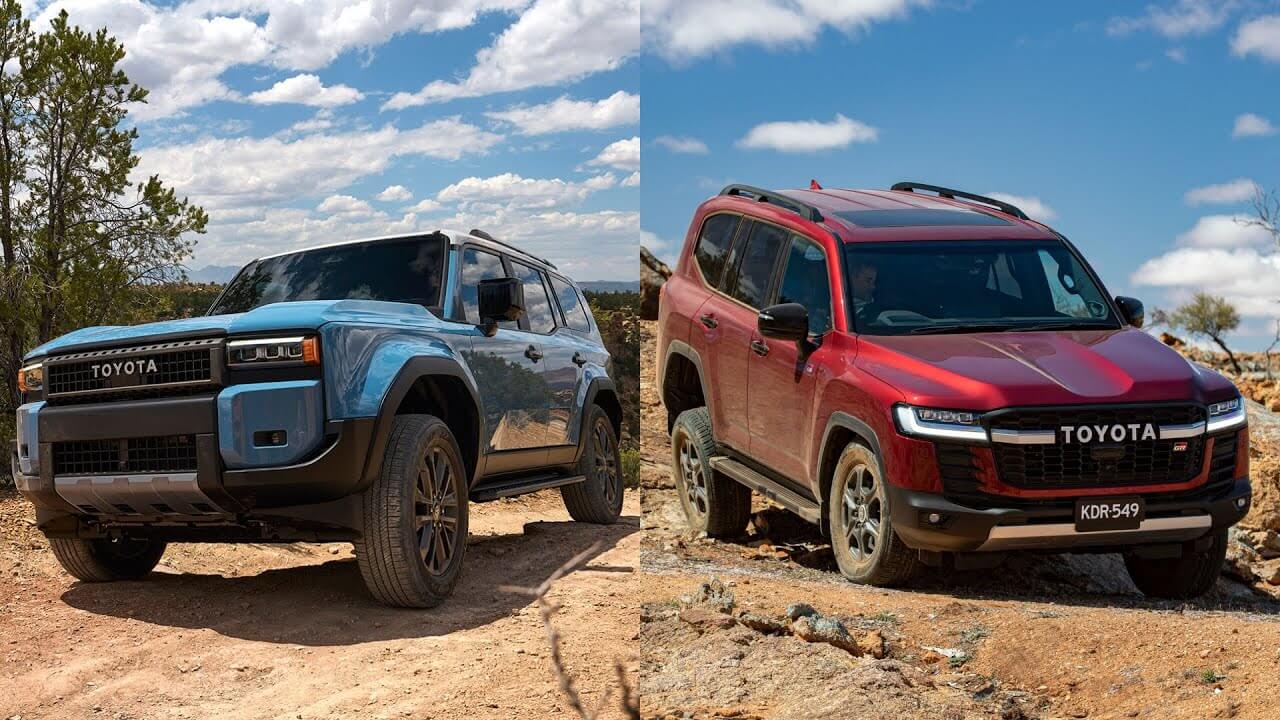
In the Nigerian automotive landscape, few names (Toyota Prado vs Land Cruiser) command as much respect, aspiration, and trust as the Toyota Land Cruiser and the Toyota Prado. These aren’t just SUVs; they are status symbols, reliable workhorses, and often, a mobile fortress designed to withstand the very worst our infrastructure can throw at them.
For the serious buyer, however, the choice between these two legendary siblings often comes down to more than just ego. It’s a pragmatic calculation involving budget, engine size, maintenance complexity, and real-world durability on everything from the slick tarmac of Lekki to the rough, laterite roads of the hinterlands.
This deep dive settles the debate once and for all. We’re going beyond mere specifications to look at what really matters to the Nigerian car owner: reliability, resale value, and the true cost of ownership.
Unpacking the Toyota DNA: Land Cruiser vs Prado
The fundamental difference between the Toyota Prado and the Land Cruiser lies in their original design brief and size. Think of the Land Cruiser (the full-size 300 Series, or the popular J200 generation) as the elder statesman, the one built for conquering continents. The Prado (the J150 generation) is its younger, slightly smaller, and arguably more agile relative, often called the “Light Duty” Land Cruiser.
The Land Cruiser: A Global Icon of Rugged Luxury
The Land Cruiser (LC) is Toyota’s flagship SUV, dating back over 70 years. It is built on a massive, heavy-duty frame (body-on-frame architecture) designed for maximum strength and endurance.
- Size and Presence: It is visibly larger, wider, and heavier than the Prado, commanding immense respect on the road, a factor not to be underestimated in Nigeria.
- Engine Power: Typically features larger engines, like the powerful V8 or the newer Twin-Turbo V6 in the LC300. This provides superior acceleration and towing capacity, though it comes at a significant cost in fuel consumption.
- Target Market: The choice for government fleets, oil & gas executives, and anyone whose journey frequently involves long-distance travel across challenging, unpaved terrains.
The Prado: The Practical Powerhouse
The Prado takes the Land Cruiser’s legendary off-road capability and packages it in a more city-friendly, fuel-efficient size. It’s the perfect blend of luxury and ruggedness.
- Dimensions: It is shorter and narrower, making it easier to navigate the tight streets and heavy traffic of Lagos or Kano.
- Engine Choices: Commonly features the 4.0L V6 petrol or the more common 2.7L/3.0L diesel/petrol engines. These are highly reliable but offer less brute power than the Land Cruiser’s typical offerings.
- Target Market: A favourite of successful entrepreneurs, middle management executives, and families needing a dependable, comfortable, and highly capable vehicle for a mix of city driving and occasional interstate travel.
Technical Specifications: The Numbers Game
Comparing the most popular variants in the Nigerian used and tokunbo market (typically the J200 Land Cruiser and the J150 Prado) reveals the core mechanical difference.
| Feature | Toyota Land Cruiser (J200/LC300) | Toyota Prado (J150) |
| Chassis | Heavy-Duty Body-on-Frame | Medium-Duty Body-on-Frame |
| Engine (Common) Range | 4.6L/5.7L V8 (J200), 3.5L TT V6 (LC300) | 2.7L I4, 4.0L V6, 3.0L Turbo Diesel |
| Seating Capacity | Typically 8 Seats | 7 Seats |
| Ground Clearance | Slightly Higher (for maximum off-road articulation) | High (Excellent for rough roads) |
| Weight | Significantly Heavier (More robust structure) | Lighter (Better fuel economy) |
| Luxury Trim Level | VX, VXR, GXR | TX, TXL, VX, VXL |
Price & Market Value in Nigeria: The Naira Conversation
This is where the rubber meets the road for most Nigerian buyers. Exchange rate fluctuations and import duties have pushed the prices of both new and tokunbo models sky-high, but a clear price hierarchy exists.
The Land Cruiser Price Bracket (LC200/LC300)
The Land Cruiser is undeniably the more expensive vehicle. Its higher initial cost, coupled with greater import duties due to its larger engine and higher luxury classification, places it at the very top tier.
- Older Tokunbo (2008 – 2012 LC200): ₦35,000,000 to ₦65,000,000
- Newer Tokunbo (2018 – 2021 LC200/Early LC300): ₦85,000,000 to ₦150,000,000
- Brand New (LC300): Starting from ₦170,000,000 and can exceed ₦250,000,000 depending on trim and customisation.
The Prado Price Bracket (J150)
The Prado provides a more accessible entry point into the “Land Cruiser Family,” offering near-identical ruggedness for a fraction of the cost, especially for older models.
- Older Tokunbo (2010 – 2014 J150): ₦28,000,000 to ₦50,000,000
- Newer Tokunbo (2018 – 2021 J150): ₦65,000,000 to ₦100,000,000
- Brand New (J150/New Gen): Typically in the ₦140,000,000 to ₦160,000,000 range.
Key Takeaway: The Prado holds a significant ₦20,000,000 to ₦50,000,000 price advantage over the equivalent-year Land Cruiser, making it the practical choice for budget-conscious buyers who still demand premium off-road capability.
Maintenance and Fuel Consumption: The Hidden Cost of the Ride
The cost of purchase is only the beginning. In Nigeria, long-term operational costs often dictate a vehicle’s success.
Fuel Consumption: A Tale of Two Thirsts
The large V8 and Twin-Turbo V6 engines in the Land Cruiser are powerful but inherently thirsty. Even the diesel variants consume a considerable amount of fuel, given their immense weight. The reality is that the LC will require more frequent trips to the petrol station, a painful experience with the current price of fuel.
The Toyota Prado, particularly the 4.0L V6 or the popular 3.0L Diesel engine models, is known for its relatively better fuel economy. It’s an engine size that offers a sensible balance of power for overtaking and torque for rough roads without completely emptying your tank.
Maintenance and Parts
Both vehicles benefit from the “Toyota advantage” in Nigeria: spare parts are widely available, and mechanics are familiar with the platform. You can find a competent technician for either model from Ladipo Market in Lagos to spare part dealers in Abuja.
However, the Land Cruiser, especially the high-end VXR trims, often incorporates more complex electronics, sophisticated suspension systems (like Kinetic Dynamic Suspension System – KDSS), and larger, more expensive brake components. When these fail, the repair bill can be astronomical.
The Prado’s design is simpler and uses slightly more common parts, making its routine service and major repairs noticeably cheaper on average. For instance, replacing an LC V8’s radiator in Lagos due to overheating in traffic (a common issue) will likely cost more than the equivalent part for a Prado V6.
Which is Best for Nigerian Roads? Performance and Durability
Both SUVs are descendants of a 70-year history of tackling the world’s most brutal terrains. They are both built on the rugged Body-on-Frame chassis, a crucial feature for any vehicle regularly driving on pothole-ridden, unpaved Nigerian highways. The monocoque chassis of many luxury crossovers simply cannot withstand the persistent punishment.
Durability and Chassis Strength
- Land Cruiser: The chassis is over-engineered. It is a tank. Its sheer size and weight ensure a majestic, stable ride, often gliding over major bumps that would shake a smaller SUV. Its suspension components are heavy-duty, built for sustained abuse. If your route involves frequent, severe off-roading, the LC is technically superior.
- Prado: Its slightly shorter wheelbase and lighter body make it more nimble. This is a massive advantage in avoiding the countless potholes and navigating the tight turns of a bustling city market. While not as heavy-duty as the LC, the Prado’s suspension is incredibly robust and has earned its reputation in Nigeria for its ability to absorb impact and maintain comfort.
Comfort and Luxury
In their modern iterations, both vehicles offer exceptional comfort, especially in high-end trims (VXL/VXR).
- Land Cruiser: Offers a more spacious and opulent interior, with wider seats and more legroom, making it the perfect vehicle for a governor or CEO who spends hours travelling between cities. The interior insulation is also generally thicker, creating a quieter, more serene cabin experience.
- Prado: Offers a practical luxury. The cabin is well-appointed, but the focus remains slightly more on utility. The tighter dimensions mean the third row, though present, is more suited for children or short trips.
The Verdict: Prado or Land Cruiser for the Nigerian Buyer?
Choosing between the Toyota Prado vs Land Cruiser is essentially a question of scale and budget.
Choose the Toyota Land Cruiser if…
- Unrivalled Status is Key: You require the ultimate symbol of success and prestige on the road.
- You Need Absolute Maximum Capability: Your work or travel regularly takes you through the most remote parts of Nigeria, requiring maximum power and the heaviest-duty components.
- Budget is Secondary to Comfort: You are prepared to pay the premium on purchase price, maintenance, and fuel to have the biggest, most comfortable, and technologically advanced vehicle.
Choose the Toyota Prado if…
- You Seek the Best Balance of Value and Ruggedness: You want 90% of the Land Cruiser’s off-road capability for 60-70% of the price.
- City Driving is Primary: You spend most of your time in urban traffic, but need the ground clearance and suspension integrity to handle terrible city and suburban roads effortlessly.
- Efficiency and Maintenance Cost Matter: You want lower running costs (fuel and routine service) while retaining the legendary Toyota reliability and high resale value.
The Final Say for the Nigerian Market:
For the vast majority of Nigerian business owners, top-level professionals, and thriving families, the Toyota Land Cruiser Prado is the winner. It offers the perfect marriage of necessary ruggedness for our challenging roads and sensible economics for our challenging economy. It handles the potholes, offers adequate luxury, and crucially, doesn’t demand the exorbitant running costs of its larger sibling.
The Land Cruiser is the definitive king, but the Prado is the practical and tactical choice that continues to dominate Nigerian vehicle sales for good reason.
1 thought on “Toyota Prado vs Land Cruiser Difference: The Ultimate SUV Showdown on Nigerian Roads”