
Welcome to the World of Car Ownership
The step you’re about to take is about more than just transportation; it’s about freedom. It’s the freedom to visit family without relying on public transport, the ability to pursue new opportunities, and the simple joy of a weekend drive. The connection a person forms with their first car is unique and deeply human. It becomes a reliable partner in your daily life. Choosing the right partner is paramount, and in Nigeria, the Toyota brand has earned its reputation as the most dependable choice for users starting this journey. This guide is designed to ensure your first car ownership experience is empowering, not overwhelming.
Why Toyota Camry & Corolla Dominate the Nigerian Market for First-Time Buyers

The sight of a Toyota Camry or Corolla on Nigerian roads is as common as the sun in the sky. This isn’t a coincidence; it’s the result of decades of proven performance under demanding local conditions. For a first-time buyer, these vehicles represent the safest, most logical investment. Their dominance is built on four unshakable pillars that directly address the core concerns of any new car owner in Nigeria.
Unmatched Reliability and Durability
The primary reason Toyota reigns supreme is its legendary reliability. Both the Camry and Corolla are engineered to endure. They are built with a philosophy of function over flash, resulting in engines, transmissions, and core components that can withstand years of use and abuse. For a first-time buyer, this translates to peace of mind. You are buying a car less likely to leave you stranded on the Third Mainland Bridge or surprise you with catastrophic engine failure. Their robust construction makes them particularly well-suited to handle the challenging and often unpredictable Nigerian road conditions, from city potholes to less-maintained rural roads. This inherent toughness is the foundation of the human-to-car trust that so many Nigerian users have in the Toyota brand.
Fuel Efficiency: A Lifeline in Nigeria
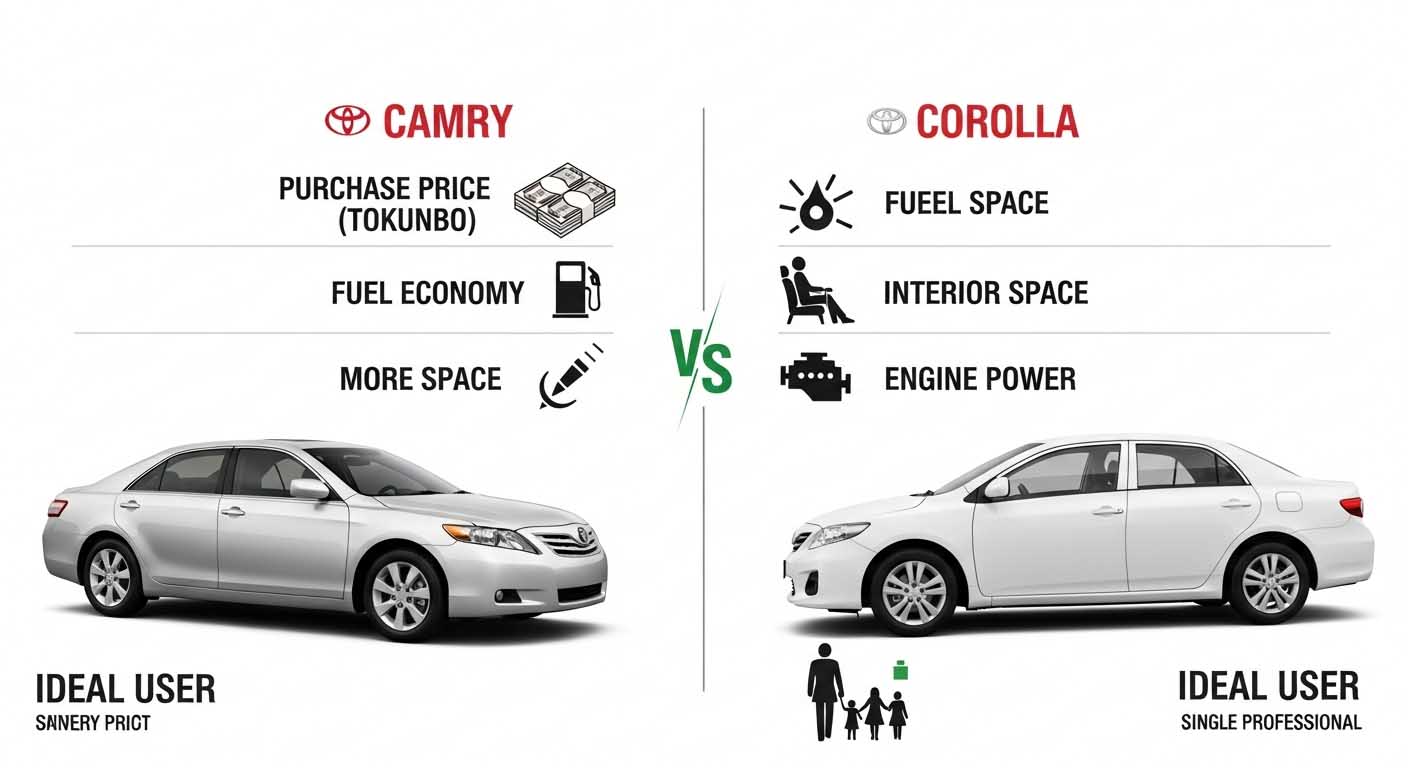
In an economy where fuel prices can be volatile, fuel efficiency is not a luxury—it’s a critical factor in the total cost of ownership. Both the Toyota Camry and Corolla are renowned for their impressive mileage. The Corolla, with its typically smaller 1.8-litre four-cylinder engine, is the undisputed champion of frugality, making it an ideal choice for daily commuting and budget-conscious drivers. The Camry, often equipped with a 2.4-litre or 2.5-litre four-cylinder engine, also delivers excellent fuel economy for its class, offering a perfect balance of power and efficiency. This focus on saving you money at the pump is a key reason why these models are so popular among first-time buyers looking to manage their monthly expenses effectively.
Abundant Spare Parts and Ease of Maintenance
One of the biggest anxieties for new car owners is maintenance. What happens when something goes wrong? With a Camry or Corolla in Nigeria, the answer is simple: you can find a solution almost anywhere. The sheer number of these cars on the road has created a vast and accessible ecosystem of spare parts and mechanical expertise. From the Ladipo market in Lagos to workshops in Kano, original (OEM), high-quality aftermarket, and even neatly used “Tokunbo” spare parts are readily available. This accessibility drives down repair costs and reduces vehicle downtime significantly. You are never far from a mechanic who understands the inner workings of your Toyota, making routine maintenance and unexpected repairs far less stressful than with less common brands.
Strong Resale Value
While you’re focused on buying, it’s wise to think about the day you might sell. A car is a depreciating asset, but some depreciate far more slowly than others. Due to their unwavering reputation for reliability and low maintenance costs, the Toyota Camry and Corolla hold their value exceptionally well in the Nigerian market. When it’s time to upgrade, you can be confident that you will recoup a significant portion of your initial investment. This strong resale value makes the initial purchase less of a sunk cost and more of a smart financial decision, providing a crucial safety net for first-time buyers.
The Big Decision: New vs. Tokunbo (Imported Used) for Nigerian Roads
This is perhaps the most significant choice a first-time buyer will make. The allure of a brand-new car is undeniable, but the value proposition of a foreign-used vehicle, or “Tokunbo,” is extremely compelling in the Nigerian context. The Nigerian used car market is not just a small segment; it’s a massive industry. It was valued at USD 1.14 billion in 2024 and is projected to grow significantly, demonstrating its central role in the nation’s automotive landscape. However, recent economic pressures are reshaping this market.
Buying a Brand New Toyota Camry or Corolla
The Pros:
- Peace of Mind: A new car comes with a manufacturer’s warranty, typically for three to five years. This covers major components and protects you from the cost of unexpected factory defects.
- Pristine Condition: You get a vehicle with zero mileage, a flawless interior, and the latest technology and safety features. There are no hidden histories of accidents or poor maintenance.
- Better Financing Options: Authorised dealerships often have partnerships with banks, potentially offering more favourable financing terms than you might find for a used car.
- Modern Features: Newer models boast better fuel efficiency, more advanced infotainment systems, and superior safety standards (more airbags, stability control, etc.).
The Cons:
- Prohibitive Cost: The primary barrier is the price. Amidst high inflation and naira depreciation, the cost of a new car is out of reach for the vast majority of first-time buyers in Nigeria. Recent data shows that economic challenges are already causing a 22.3% drop in car sales, making new vehicles an even rarer sight.
- Rapid Depreciation: A new car loses a significant chunk of its value the moment you drive it off the lot. This is the steepest depreciation it will ever experience.
- Higher Insurance Premiums: Comprehensive insurance, which is essential for a new car, will be significantly more expensive than third-party insurance for an older model.
Opting for a Tokunbo (Imported Used) Toyota Camry or Corolla
The Tokunbo market is the engine of car ownership in Nigeria. These are typically vehicles imported from countries like the USA or Canada after a few years of use. While this market has faced challenges, such as a recent 83% drop in used car import value due to economic policies, leading to a surge in prices, it remains the most viable path for most buyers.
The Pros:
- Affordability: This is the number one advantage. You can purchase a well-maintained, three-to-eight-year-old Camry or Corolla for a fraction of the price of a new one. This allows you to get a more premium model (like a Camry) for the price of a much lower-spec new car.
- Slower Depreciation: The first owner absorbed the steepest part of the depreciation curve. Your Tokunbo car will lose value much more slowly, protecting your investment better.
- Proven Reliability: You are buying a model whose real-world performance and common issues are already well-documented. A quick online search or chat with a mechanic can reveal everything you need to know about a specific model year.
The Cons:
- Hidden History: The biggest risk is the unknown. The car could have been in an unreported accident, been poorly maintained, or have underlying mechanical or electrical issues that aren’t immediately apparent.
- No Warranty: Once you buy a Tokunbo car, you are solely responsible for any repairs. There is no manufacturer’s warranty to fall back on.
- Wear and Tear: Components like suspension, brakes, and tyres will have some level of wear. You must budget for immediate or near-future replacements.
- Potentially Outdated Features: You may miss out on modern infotainment systems, advanced safety features, and the latest fuel-efficiency technology.
Total Cost of Ownership (TCO) Comparison: New vs. Tokunbo
The sticker price is just the beginning of the story. To make an informed decision, you must consider the Total Cost of Ownership.
- New Car TCO: High initial purchase price + higher comprehensive insurance + lower initial maintenance costs (covered by warranty) + lower fuel costs (newer tech) = Very high upfront cost, predictable running costs.
- Tokunbo Car TCO: Lower initial purchase price + lower insurance (often third-party) + higher initial maintenance (budget for immediate servicing/repairs) + potentially higher fuel costs (older tech) = Lower upfront cost, potentially unpredictable running costs.
For a first-time buyer in Nigeria, the Tokunbo option almost always presents a lower barrier to entry. The key to success is mitigating the risks through diligent inspection and budgeting for initial maintenance, which can average around N845,000 yearly for Nigerian car users.
Navigating the Purchase: A First-Time Buyer’s Actionable Guide
Once you’ve decided between a Camry and Corolla and whether to buy new or Tokunbo, it’s time to enter the market. This process can be intimidating, but with a clear plan, you can navigate it confidently.
Setting Your Budget: More Than Just the Car Price
Your total budget should account for more than just the “for sale” price. A smart first-time buyer plans for the following:
- Purchase Price: The agreed-upon cost of the vehicle.
- Pre-Purchase Inspection (PPI) Fee: A non-negotiable cost for a trusted mechanic. Budget ₦20,000 – ₦50,000.
- Initial Repairs & Servicing: For a Tokunbo, set aside at least 10-15% of the car’s price for immediate needs like changing all fluids (engine oil, transmission fluid, coolant), brake pads, and possibly tyres.
- Paperwork & Registration: This includes customs duty verification, vehicle registration, and number plates. The cost can vary, but it is a significant expense.
- Insurance: At a minimum, you’ll need third-party insurance. Comprehensive is recommended for higher-value cars.
- Contingency Fund: Always have extra cash on hand for unexpected issues that may pop up in the first few weeks of ownership.
The Critical Pre-Purchase Inspection (PPI) for Tokunbo Cars in Nigeria
Never, ever buy a Tokunbo car based on its shiny exterior alone. A thorough Pre-Purchase Inspection by a mechanic you trust (not one recommended by the seller) is your single most important defence against buying a problematic vehicle.
Your mechanic’s checklist should include:
- Engine Check: Look for oil leaks, listen for strange noises, check the colour of the engine oil and transmission fluid, and perform a diagnostic scan for any error codes.
- Transmission Test: The car should shift smoothly without jerking or delays, both when accelerating and decelerating.
- Suspension and Frame: Inspect for signs of accident damage (uneven panel gaps, mismatched paint) and check the condition of shocks, struts, and bushings, which take a beating on Nigerian roads.
- Electrical Systems: Test every single button, switch, and light—windows, wipers, air conditioning, stereo, headlights, etc.
- Tire and Brake Inspection: Check tyre tread depth and the condition of brake pads and discs.
- Test Drive: A comprehensive test drive on different types of roads (smooth, bumpy, city traffic) is essential to feel how the car handles.
Where to Buy Your Toyota in Nigeria
- Authorised Dealerships (for New Cars): Companies like Toyota Nigeria Limited (TNL) and its accredited dealers are the only places to buy a brand-new, warranty-backed Toyota.
- Major Car Markets (for Tokunbo): Places like Berger Auto Market in Lagos are famous for their vast selection of Tokunbo cars. The competition can lead to better prices, but you must be extremely vigilant and always go with your mechanic.
- Online Car Platforms: Carlots.ng offers a convenient way to browse inventory from various sellers across Nigeria. However, always insist on a physical inspection before any money changes hands.
- Private Sellers: Buying directly from an owner can sometimes get you a well-maintained car at a good price. However, this requires even more due diligence regarding ownership documents and the car’s history.
Essential Paperwork, Registration & Insurance
Ensuring your car’s paperwork is complete and legitimate is crucial for your security and peace of mind. For a Tokunbo car, you must verify the following:
- Customs Papers (Duty and Clearing Documents): This is the most important set of documents. It proves the car was legally imported and that all required duties were paid. Verify that the VIN on the papers matches the car’s VIN.
- Bill of Lading: This document tracks the shipment of the car from its country of origin.
- Vehicle Registration and Proof of Ownership: Once purchased, you must register the car in your name to obtain a new proof of ownership, vehicle license, and number plates.
After registration, you are legally required to have at least Third-Party motor insurance. This covers damage you might cause to another person’s vehicle or property.
Owning Your Toyota: Proactive Maintenance & Tackling Common Issues
Your relationship with your car doesn’t end after the purchase; it begins. Proactive maintenance is the key to ensuring your Toyota serves you reliably for years to come and protects its resale value.
Your Nigerian-Specific Maintenance Schedule
The manufacturer’s service manual is a great guide, but Nigerian conditions require a more aggressive maintenance schedule.
- Engine Oil and Filter: Change every 5,000 km or 4-5 months, whichever comes first. The combination of heat, dust, and traffic is harsh on engine oil. Reputable workshops may charge between ₦150,000 to ₦300,000 annually for minor services like this.
- Air Filter: Inspect every oil change and replace every 10,000-15,000 km. Our dusty environment clogs filters quickly, affecting fuel efficiency and performance.
- Suspension Check: Have your mechanic inspect your shocks, ball joints, and bushings every 6 months. Nigerian road conditions are the primary enemy of suspension components.
- Tire Rotation and Alignment: Rotate your tyres every 10,000 km and check alignment annually to ensure even wear and safe handling.
- Brake System: Check brake pads and fluid levels during every service. Don’t wait until you hear squealing.
- Cooling System: In our hot climate, the cooling system is critical. Ensure your coolant is clean and at the right level. A flush every two years is recommended.
Common Issues in Tokunbo Camry & Corolla (and How to Spot Them)
While famously reliable, no car is perfect. Here are some common issues to look out for in popular Tokunbo models:
Toyota Camry (especially 2007-2011 models):
- Excessive Oil Consumption (2AZ-FE engine): The 2.4L 4-cylinder engine in these models can be prone to burning oil. How to spot: Check the oil level during inspection; a very low level is a red flag. Look for blueish smoke from the exhaust on startup or acceleration.
- Melting/Sticky Dashboard: Under intense sun, the dashboards of this generation can become sticky or melt. How to spot: This is a purely visual and tactile check. Press on the dashboard surface.
- Transmission Hesitation: Some users report a slight jerk or hesitation in the transmission, particularly on the 5-speed automatic. How to spot: During the test drive, pay close attention to how smoothly the car shifts under light and heavy acceleration.
Toyota Corolla (especially 2009-2013 models):
- Lower Control Arm Bushings: Due to rough roads, the front suspension bushings can wear out prematurely, leading to clunking noises over bumps. How to spot: Listen carefully for noises from the front end when driving over uneven surfaces.
- Water Pump Failure: Though not extremely common, a failing water pump can lead to overheating. How to spot: Look for coolant leaks around the front of the engine and check that the temperature gauge stays in the normal range during the test drive.
- Starter Motor Issues: Some models may develop a slow-cranking issue over time. How to spot: The engine should turn over and start briskly. Any sign of sluggishness could indicate a failing starter or a weak battery.
Sourcing Spare Parts in Nigeria
You’ll encounter three main categories of spare parts:
- Original (OEM): The best quality, sold by accredited dealers, but also the most expensive.
- High-Quality Aftermarket: Often referred to as “Taiwan” parts, these are new parts made by other companies. Quality can vary greatly, so buying from a trusted supplier is key.
- Tokunbo Parts: Used parts salvaged from other vehicles. For major components like engines or transmissions, this can be a cost-effective option, but it comes with its own risks.
For critical components like brake pads, suspension parts, and engine sensors, it is highly recommended to use OEM or high-quality aftermarket parts for safety and reliability.
Driving and Living with Your Toyota in Nigeria: Practical Considerations
Owning a car is about the daily experience. How does it feel to drive? How does it fit into your life? This is where the human connection with the machine is truly forged.
Fuel Economy in Real-World Nigerian Driving
Manufacturer fuel economy figures are often achieved in ideal lab conditions. In Nigeria, with its stop-and-go traffic, your actual mileage will be different.
- Toyota Corolla (1.8L): Expect around 8-10 km/litre in heavy city traffic and 12-15 km/litre on the highway.
- Toyota Camry (2.4L/2.5L): Expect around 6-8 km/litre in the city and 10-13 km/litre on the highway. These are real-world estimates that will help you budget for fuel more accurately.
Navigating Nigerian Roads and Traffic
Both cars are built to handle the rigours of local driving, but they do it differently. The Corolla’s slightly smaller size and nimble handling make it a champion of navigating tight city streets and finding parking. Its suspension is tough and designed for practicality. The Camry, being larger and heavier, offers a more comfortable and composed ride, soaking up bumps and imperfections in the road more effectively. This makes it a superior choice for longer journeys or for those who prioritise ride comfort over agility.
Safety Features and Your Peace of Mind
Safety is a critical concern. When reviewing a Tokunbo Toyota, pay attention to the safety features. Most models imported from the US (a major source of Nigeria’s imported passenger cars) will come standard with:
- Multiple Airbags: Front, side, and curtain airbags are common in post-2007 models.
- Anti-lock Braking System (ABS): Prevents the wheels from locking up during hard braking, allowing you to maintain steering control.
- Factory-fitted Immobiliser: This security feature prevents the engine from starting without the correct key, offering a basic but effective layer of anti-theft protection. While these features might seem basic by today’s standards, they provide a crucial layer of security and safety, contributing significantly to your peace of mind.
Interior Comfort and User-Friendliness
The interior of your car is where you will spend hundreds of hours. It’s your personal space.
- Corolla’s Interior: The focus is on functionality, durability, and ergonomic simplicity. The controls are intuitive and easy to reach. The materials are built to last rather than to impress. It’s a no-nonsense, practical cabin that gets the job done.
- Camry’s Interior: This is where the Camry clearly steps up. It offers more space, especially for rear passengers, more comfortable seats, and generally higher-quality materials. The cabin is quieter and feels more premium, making the human experience during long commutes or family trips more pleasant. This enhanced comfort is often a key deciding factor for buyers willing to stretch their budget.
The Human Touch: Why Local Expertise and Authentic Advice Matter
In the age of global information, it’s easy to find a generic review of a Toyota Camry or Corolla. However, that advice often misses the crucial context of the Nigerian experience.
Beyond Generic Advice: The Value of Nigerian-Specific Experience
A review from a user in Europe or North America won’t tell you how a car’s air conditioning holds up in Lagos humidity, how the suspension handles the craters on the Benin-Sagamu expressway, or where to find a reliable mechanic in Abuja who won’t exploit your lack of knowledge. The advice from a fellow Nigerian driver, a local mechanic, or a detailed guide like this one is invaluable because it’s grounded in our shared reality. It addresses the specific challenges and considerations of car ownership in Nigeria.
Verifying Information: Your Shield Against Misleading Content
The car market, especially the Tokunbo segment, can have its share of misinformation. Sellers may downplay issues, and online ads can be deceiving. Always cross-reference information. If a deal seems too good to be true, it almost certainly is. Trust your gut, and more importantly, trust the diagnostic report from your independent mechanic over the words of a seller. This diligence is your best shield.
Building Your Network: Connecting with Local Car Enthusiasts
One of the best resources you can have is a small network of trusted individuals. Find a reliable, honest mechanic and build a relationship with them. Connect with other Toyota owners, either in person or through online forums and social media groups specific to Nigeria. The shared experiences and collective knowledge of these users can provide support and solutions you won’t find in a car manual, fostering a real human connection within the ownership community.
Conclusion
Your journey to becoming a car owner in Nigeria is an exciting one, and choosing a Toyota Camry or Corolla is an intelligent first step. You are opting for a legacy of reliability, affordability, and peace of mind that is perfectly attuned to the demands of our environment.
The final decision boils down to your personal priorities and budget. The Toyota Corolla is the quintessential first car: incredibly dependable, remarkably fuel-efficient, and the most affordable to buy and maintain. It is the logical, pragmatic choice for the budget-conscious buyer focused on utility. The Toyota Camry offers a significant step up in comfort, space, and refinement. For those who can stretch their budget, it provides a more premium experience without sacrificing the core Toyota values of reliability and strong resale value.
For most first-time buyers, a carefully selected Tokunbo model will offer the best balance of value and accessibility. The key is to approach the purchase with diligence: set a comprehensive budget that includes post-purchase maintenance, insist on a thorough pre-purchase inspection from a trusted mechanic, and verify all paperwork meticulously. By arming yourself with this knowledge, you transform from an anxious first-timer into an empowered buyer. You are not just buying a car; you are investing in your freedom, your mobility, and a reliable partner for the road ahead. Welcome to the driver’s seat.