
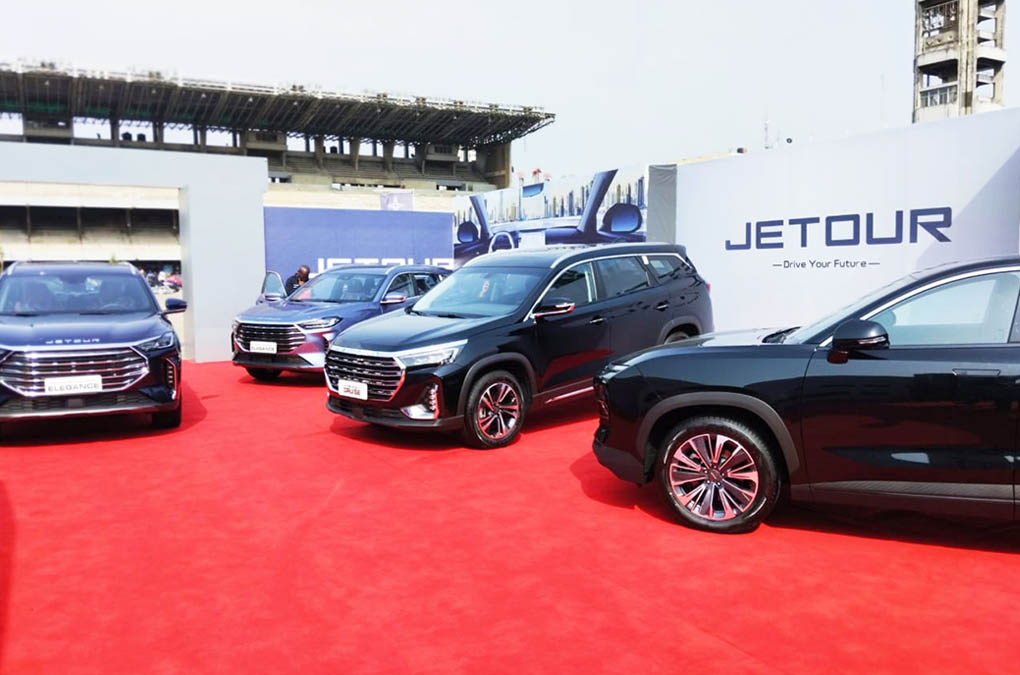

Walking through Ikeja or Ojota, or even driving from Victoria Island to Ajah, you can already see the change happening. Chinese car brands Geely, Chery (Jetour), Chang’an, MG, and others are becoming increasingly visible. Their appeal isn’t just about novelty; it’s about pricing, features, and being more tuned into what many Nigerians need: Brand new with affordability, fuel efficiency, lower maintenance, and finance options.
There is strong evidence that Chinese brands are rapidly gaining new-car market share in Nigeria. Below I unpack what is known, what is plausible, and how the next decade could reshape the automotive landscape here.


Current Reality: What Data Shows
Here’s what recent data and reporting show about Chinese cars in Nigeria and Africa generally.
Chinese Brands Really Making Strides
- A BusinessDay article (September 2025) notes that Chinese brands are overtaking others in Nigeria’s new car market.
- Jetour, one of the Chinese SUV/ crossover brands (under Chery), has recorded high early sales in Nigeria: in weeks following its launch, it sold 568 units across its Dashing and X70 Plus models, approaching its year-end target of ~1,500 units.
- According to “Nigeria’s car market – Facts & Data 2025” from Focus2Move: in the first half of 2025 (H1), Nigerian vehicle market volume dropped ~18.4% compared to the same period in 2024. But in that same period, MG (a Chinese brand via SAIC) rose ~60.6% into 4th place among brands and was “about to overtake Hyundai on the podium.”
Electric Cars & Chinese EVs
- Reuters / Bloomberg etc. signal that Chinese EVs are making inroads in Nigeria, spurred by rising fuel prices and (in some areas) government interest. However, uptake remains small relative to petrol/diesel cars, due to infrastructure, high cost of EVs, and unreliable power supply.
- More broadly in Africa, Chinese automakers are exporting significantly: from January to May 2025, 222,000 Chinese‐made cars were exported to Africa, up ~67% year-on-year. This includes both conventional and new energy (EV/hybrid) models.
Why Chinese Cars Are Rising: Key Drivers
Several interlinked factors explain why Chinese car brands are becoming more attractive in Nigeria now, and why many believe they could overtake Japanese and European giants in time.
Price & Value for Money
- Chinese cars tend to be considerably cheaper in the same vehicle category. For example, BusinessDay notes that a Chery Tiggo 4 or Tiggo 7 Pro Max might sell for ₦15.4 million to ₦29.4 million, whereas a new‐Toyota Camry (2.5L / 3.5L V6) may go for ₦48 million to ₦53 million depending on trim and specs.
- For many buyers, maintenance, spare parts, and fuel consumption are big concerns; Chinese models are positioning themselves to offer acceptable quality with lower running costs. Some brands also offer warranty packages, more modern features for the price, etc.
Currency, Inflation, and Import Duties
- The sharp depreciation of the naira, rising inflation, and high import costs make new imports expensive. Many “Tokunbo” cars have also seen big price hikes because of increased customs duty (e.g., import duties ~39% etc.), which affect both used and new imports.
- As new car prices go up, more consumers look for more affordable alternatives, whether new Chinese cars or slightly newer used foreign cars, that balance cost and features.
Financing & Consumer Preferences
- Some Chinese car dealers are offering more accessible finance options. Bank auto finance has been growing, enabling more middle‐income Nigerians to consider new vehicles rather than just used.
- Brand perception is shifting: earlier, “new car = prestige, used car = compromise.” But rising prices make compromise more necessary, many buyers now accept that a lower‐priced Chinese car with decent features might offer better overall cost of ownership than a high‐cost Toyota or Lexus (especially when depreciation, repair/parts, and resale are considered).
Government Policy & Market Opportunity
- Nigeria lacks strong domestic auto production at scale; most vehicles are imports. So foreign automakers see opportunity. Chinese manufacturers are among the most aggressive in exporting to Africa, often with strategies to localize assembly or supply parts locally.
- There is also increasing public and policy interest in EVs/new energy and hybrids (because of climate, urban air quality, rising fuel costs). If infrastructure improves, Chinese EV/hybrid offerings could take advantage.
Why Chinese Cars Have Taken Over
1. Price and Affordability
The naira’s steady decline and rising import costs have made Tokunbo cars painfully expensive. A clean 2015 Toyota Corolla can go for ₦16 million in 2025, while a brand-new Chery Tiggo 7 Pro sells for around ₦18–20 million. For many middle-class buyers, the calculation is simple: why buy a 10-year-old Toyota when you can get a brand-new Jetour with warranty for nearly the same price?
2. Bank Financing Is Changing Ownership
Commercial banks and microfinance institutions now structure auto loans that specifically target Chinese brands. Jetour, Geely, and MG all have partnerships with Nigerian banks, allowing professionals especially bankers, tech workers, and civil servants to spread payments over 24–48 months.
For the first time, owning a brand-new car is no longer just for the elite. It’s now a middle-class reality, and the cars making it possible are overwhelmingly Chinese.
3. Design, Features, and Technology
The era when Chinese cars were dismissed as “cheap copies” is gone. Today’s models boast touchscreen infotainment, panoramic sunroofs, adaptive cruise control, and hybrid options. Nigerians who step into a Jetour X70 Plus often compare it to a Lexus RX, except it costs less than half the price.
Electric Cars: China’s Secret Weapon
While Europe and the U.S. focus on premium EVs, Chinese automakers are flooding emerging markets like Nigeria with affordable hybrids and electric cars.
- MG4 EV, now sold in Lagos, offers a 450km range at ₦35–40 million, far cheaper than a Tesla or European EV import.
- BYD and Changan hybrids are also quietly entering the market, appealing to ride-hailing drivers tired of fuel price hikes.
Even though Nigeria’s charging infrastructure remains weak, Chinese EV makers are betting that Lagos, Abuja, and Port Harcourt will eventually catch up. They want to own the market before competitors wake up.
Where Chinese Cars Might Not yet Beat Toyota / Lexus (and What They Must Prove)
To overtake the long-dominant brands, Chinese manufacturers will need to address several challenges:
- Resale Value & Durability:
Toyota and Lexus have strong reputations in Nigeria for lasting long, retaining value, and being easy to repair. Many buyers weigh these heavily. Chinese brands must prove over time that their cars can survive Nigerian roads, heat, fuel quality, etc. - Spare Parts & Service Network:
Even when the cars are affordable upfront, lack of reliable spare parts, maintenance knowledge, or dealer network can reduce total cost advantage. If parts are delayed, expensive, or rare, or if servicing is not local, that hurts consumers. - Quality & Reliability Over Time:
There are stories of earlier Chinese models suffering with quality electronics, build, safety features, etc. Overcoming perception (and actuality) of early failure or poor safety will be key. - Infrastructure, especially for EV/hybrids:
Charging stations, reliable electricity, battery maintenance, etc., are still weak in many parts of Nigeria. Without improvements, wide EV penetration will be slow. - Financing Terms, Tariffs, and Regulations:
Import duty, customs regime, taxation, import regulations can swing margins heavily. Changes in policy (tariffs, incentives) will matter. And inflation / exchange rate risk remains very large for importers and purchasers.
Predictions: Where Might Things Be in 5-10 Years
Given what we know, here are reasonable forecasts for the next decade, especially if current trends continue or even accelerate.
| Timeframe | What we might see happen | What needs to happen for that to be realized |
|---|---|---|
| Next 2-3 years | • Chinese brands increase market share among new car buyers significantly. Shifting from single digits to 20-30% in certain segments (SUVs, crossovers, compact cars). • More Chinese EV / hybrid models imported / launched. • More auto-financing deals, installment plans, lease-to-own options become mainstream for new Chinese cars. • Some public institutions/governments (states) begin buying more Chinese cars for fleets because cost savings are clear. | • Continued stable import policy, reasonable tariffs. • Better after-sales networks for Chinese brands. • Financing sector engages deeply. • Consumer experience with Chinese cars builds trust. |
| 5-10 years | • Chinese brands may challenge or overtake Toyota / Lexus / other Japanese / European brands in many mass-market new car segments, especially mid / lower-mid segment. • Many of today’s brand-new Chinese cars will enter the Nigerian used car market (i.e. “Tokunbo” equivalent) once they are 3-5 years old. That will expand the choices for used-car buyers. • EVs / hybrids from Chinese automakers may begin to scale meaningfully — especially hybrids, possibly some pure EVs in Lagos, Abuja, etc. • Lexus or Toyota may retain edge in luxury / prestige / resale value, but their dominance in the broader market will be more contested. |
Conclusion
Chinese car brands are on an upward trajectory in Nigeria. The combination of lower pricing, increasing availability of models, aggressive market expansion by Chinese manufacturers, inflation and currency challenges for used foreign imports, and changing consumer preferences are creating fertile ground for change.
Toyota and Lexus still have strong positions, especially in prestige, durability, resale value, and among buyers who factor long-term reliability heavily. In the next 5–10 years, though, it’s quite plausible that Chinese cars could overtake Japanese and European brands in many new‐car segments, especially in SUVs, crossovers, entry premium cars, if the challenges (quality, parts, service, financing, policy) are addressed.



Comments 1